Digital Newsletter
Each week our editor Phil Alsop rounds up the most popular articles, videos and expert opinions. We compile this into a Digital Newsletter and send it straight to your inbox every week.
Digital Magazines
We'll let you know each time a new edition of Digitalisation World is released so that you're always kept up-to-date with the latest and greatest news and press releases.
Video Magazines
The Digitalisation World Video magazine contains the latest Zoom interviews with experts in the industry.
Since the inception of data centers, backup power infrastructure operated on a quiet, unquestioned premise: keep the lights on when the grid fails. Batteries sat in the background; Uninterruptible Power Supply (UPS) systems stood watch. The workload was steady. The system was predictable. In that model, batteries functioned as passive reserves.
Artificial Intelligence (AI) changed that assumption entirely.
AI requires something different: Immediate Power Solutions (IPS) — systems that actively absorb and release power in real time, not just during outages.
A GPU cluster running an inference workload doesn’t draw power like a row of web servers; it spikes. Power demand fluctuates from an idle baseline o peak in milliseconds, then drops and surges again. In some cases, clusters reach up to 15 times their idle power level in a fraction of a second, cycling repeatedly during a single processing task — a behavior now commonly described as AI Dynamic Power. The instability doesn’t stay local. When those surges hit UPS infrastructure that wasn’t designed to absorb them, the impact travels outward: degraded power quality, stressed grid connections, reduced compute efficiency. The UPS, long treated as an afterthought, has become a critical point of failure in the AI data center.
A chemistry problem, not a capacity problem
The reflex answer is more batteries. More capacity. More backup. But AI Dynamic Power is not a capacity problem. It is a chemistry problem — an immediate power problem.
The challenge is the ability to absorb and inject high power in milliseconds, repeatedly, without degradation, excess heat, or added infrastructure burden. What the AI data center needs is a battery that can intercept extreme bursts of energy, release them just as quickly, sustain millions of high- intensity cycles, and do it all without introducing new safety or operational risk.
Lead-acid batteries, still common in older deployments, were built for slow, steady discharges. They degrade fast under rapid cycling and fall well short of what AI loads demand. Lithium-ion offers faster response and greater energy density, but its chemistry has a known vulnerability: repeated high-frequency surges accelerate thermal stress, drive faster wear, and introduce thermal runaway risk. Managing that risk requires overbuilding battery capacity to dilute the power and thermal load, while still demanding fire suppression systems, specialized room design, and heightened insurance exposure.
Supercapacitors react in an instant but store so little energy they can’t support anything beyond a brief transient. Each of these chemistries solves only one piece of the puzzle.
Why Nickel-Zinc solves what other chemistries don’t
ZincFive’s nickel-zinc (NiZn) battery technology was designed for exactly the demands AI imposes. NiZn delivers up to three times the power density of legacy chemistries at half the footprint and one-third the weight. That combination matters: high-intensity surges get intercepted at the UPS level before they propagate through the system, and operators get that capability without sacrificing rack space or floor area.
The safety profile is inherent to the chemistry itself. NiZn operates across a wide temperature range with no thermal runaway risk, even if cooling systems fail. That eliminates the suppression infrastructure that lithium-ion requires.
On the sustainability side, NiZn produces 25 to 50% lower lifecycle greenhouse gas emissions than lead- acid or lithium-ion, uses materials that are highly recyclable, and lasts three times longer than lead-acid under real-world cycling conditions. Fewer replacements mean less waste and less downtime.
Those numbers have started to matter in procurement decisions. The 2025 Data Center Energy Storage Industry Insights Report, done by Data Center Frontier in partnership with ZincFive, found that 87 percent of operators now rank sustainability as a top factor when selecting power systems, and 72 percent report meaningful cost reductions tied to their sustainability investments. Performance and responsibility no longer compete with each other.
BC 2 AI: Built for the AI power profile
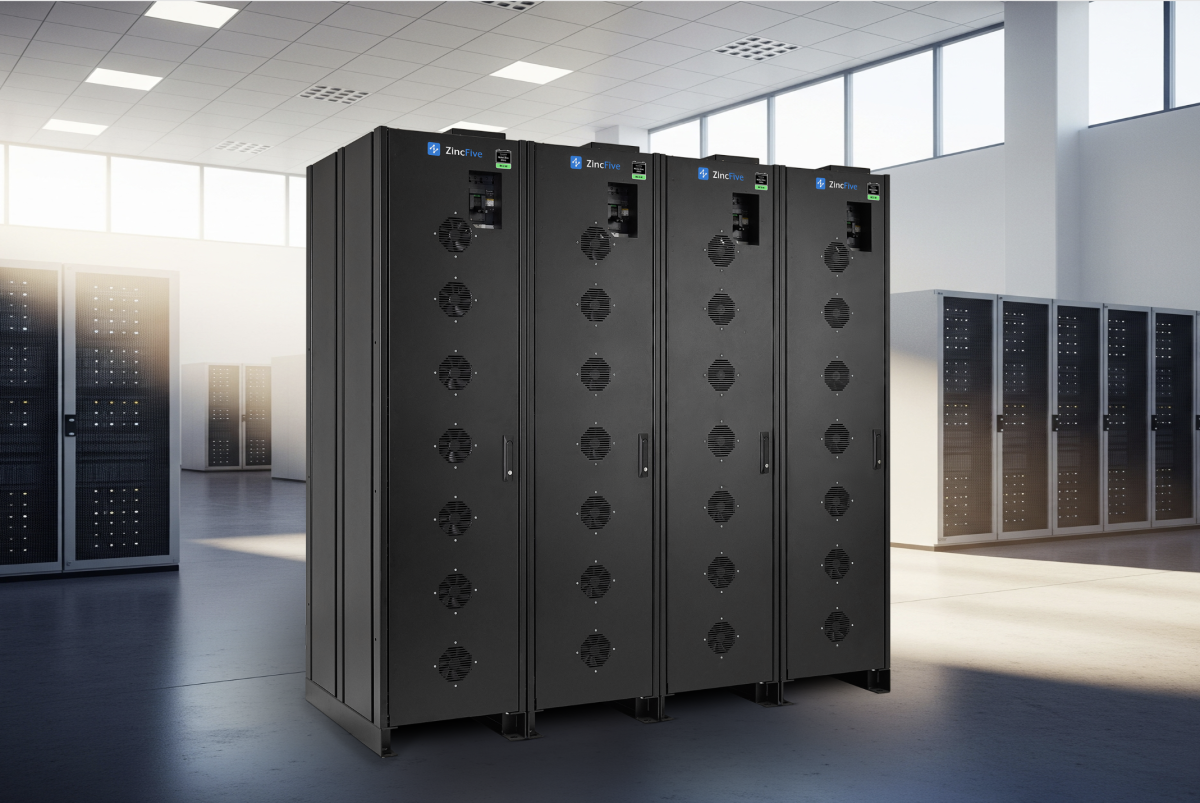
ZincFive built its new BC 2 AI UPS Battery Cabinet on the foundation of its proven BC Series platform, with a specific design goal: address the AI Dynamic Power problem from the inside out.
As an Immediate Power Solution, BC 2 AI is engineered not just to back up the load, but to actively shape it, smoothing volatility in real time while maintaining traditional UPS protection.
At the center of the system is an advanced Battery Management System (BMS) capable of millisecond response to transient surges, with patented sync charge and discharge capability and real-time pulse response built into an intelligent monitoring interface. The 90Ah NiZn battery at its core supports millions of high-intensity cycles and carries a 10-year warranty. Eliminating thermal runaway risk also removes the need to overbuild battery capacity to manage thermal load, a hidden cost that consistently inflates lithium-ion deployments.
BC 2 AI is dual-use by design, supporting AI dynamic power demands while delivering reliable backup for conventional IT workloads in the same compact cabinet. Operators deploy one system — not separate solutions for AI and traditional infrastructure.
Backward and forward compatible with megawatt-class UPS systems, BC 2 AI integrates seamlessly into existing data center infrastructure originally designed for VRLA batteries. That brownfield-friendly architecture reflects where the market stands: most operators need AI-ready power that fits within their existing infrastructure, without a mandate to rebuild from scratch.
Power that keeps pace
AI is not just changing data center workloads. It is rewriting what every supporting system needs to do. Power infrastructure that once sat passively in the background now has to actively stabilize operations, absorb unpredictable surges, and meet tightening regulatory requirements around carbon footprint and battery lifecycle management.
BC 2 AI was built for that shift. It’s fast enough to catch millisecond spikes, sustainable enough to satisfy ESG benchmarks, compact enough to fit where operators need it, and compatible enough to work within the infrastructure they already own.
The data centers that keep pace with AI won’t be the ones with the most power on tap. They will be the ones that manage it with the right chemistry. And increasingly, that means Immediate Power Solutions — high-density, fast- acting systems designed to respond at the speed AI demands. The ability to right-size those systems, free from the overbuilding that thermal risk demands of lithium, is what makes that scale practical.