Digital Newsletter
Each week our editor Phil Alsop rounds up the most popular articles, videos and expert opinions. We compile this into a Digital Newsletter and send it straight to your inbox every week.
Digital Magazines
We'll let you know each time a new edition of Digitalisation World is released so that you're always kept up-to-date with the latest and greatest news and press releases.
Video Magazines
The Digitalisation World Video magazine contains the latest Zoom interviews with experts in the industry.
Artificial Intelligence (AI) has significant potential to enhance workplace productivity and efficiency. A recent report from Zellis examines how improved AI alignment between leaders and employees could generate economic and cultural benefits for UK businesses.
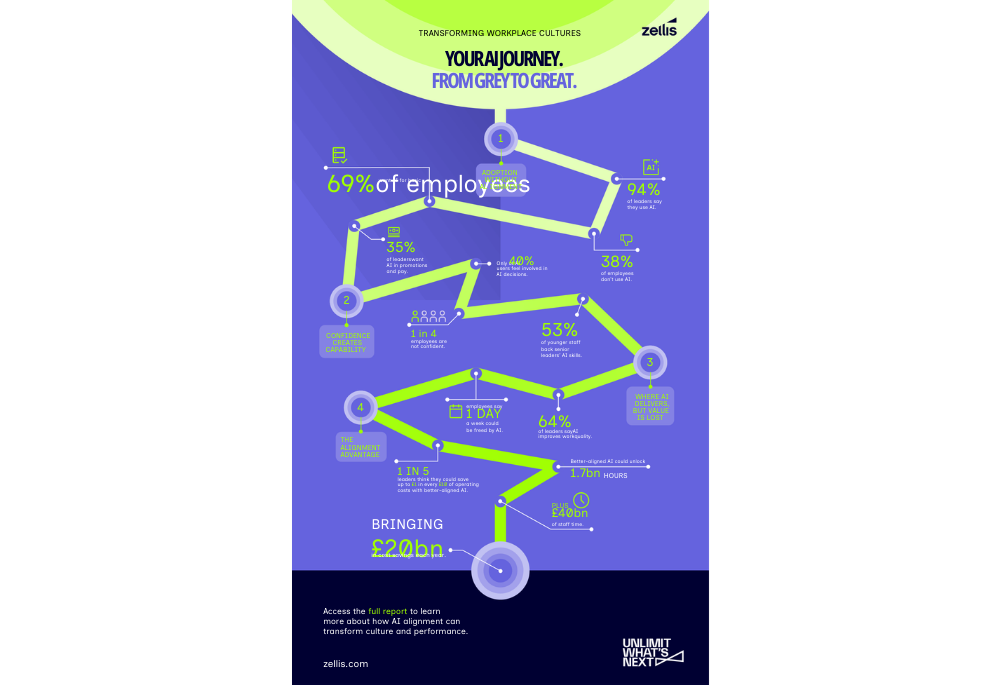
Zellis’ research identifies a “grey zone” of AI misalignment, where the strategic use of AI intended by leaders does not always reflect employees’ day-to-day experiences. While 94% of business leaders confirm AI tool usage within their organisations, 61% of employees report regular interaction with these tools. This difference highlights a gap between strategy and practical application, limiting the potential impact of AI in the workplace.
The report suggests that reducing this misalignment could lead to substantial economic effects. Employees and leaders indicate that better alignment between AI usage and work processes could recover approximately £40 billion in staff time value annually. This represents around 1.7 billion hours of working time that could potentially be redirected towards other tasks.
Improved AI alignment is also associated with potential reductions in operational costs of up to £20 billion. Leaders estimate that enhancing alignment could reduce ongoing operational costs by up to 10%, creating opportunities for reinvestment within organisations.
Differences in adoption across age groups are evident. Gen Z and Millennial employees are more likely to use AI tools regularly compared to Gen X and Baby Boomer employees. This generational variation points to a need for training and education to support broader engagement across different employee groups.
Integrating AI in a way that supports human decision-making is highlighted as important. Organisations that implement transparent AI strategies and maintain clear communication may strengthen trust and engagement. Around 61% of employees who use AI tools report that it improves their work quality and productivity.
To maximise the potential of AI, the focus is placed on alignment between strategy and implementation rather than adoption alone. AI functions as a tool to support human capability and decision-making, requiring ongoing communication and structured engagement with teams. Encouraging feedback and supporting skill development may help organisations make better use of AI capabilities.
AI alignment represents both potential economic impact and an opportunity to support workplace engagement through clearer integration of technology into business processes.