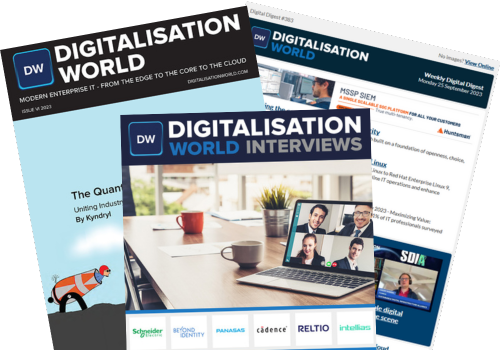
Digital Newsletter
Each week our editor Phil Alsop rounds up the most popular articles, videos and expert opinions. We compile this into a Digital Newsletter and send it straight to your inbox every week.
Digital Magazines
We'll let you know each time a new edition of Digitalisation World is released so that you're always kept up-to-date with the latest and greatest news and press releases.
Video Magazines
The Digitalisation World Video magazine contains the latest Zoom interviews with experts in the industry.
Solutions Integrator Insight Enterprises has released its 2025 Trends Report, which outlines six technology trends most anticipated to shape business strategy and investment in 2025 and beyond. The report aims to help organisations answer questions like whether they are set up efficiently for the latest developments around generative AI and if their infrastructure is updated to support their current and future business operations.
Drawing on the extensive experience of Insight technologists, the Insight 2025 Trends Report features guidance on:
• The Evolution of AI Models – The launch of DeepSeek at the beginning of the year is just one example of how the AI landscape is changing. As more businesses adopt AI, Insight’s experts look at the factors that will be integral to AI implementation. These include developments in GenAI technology, multimodal capabilities, AI orchestration and the technology’s integration with RPA, and the question around AI sustainability.
• Security Implications of AI Deployment – The impact of AI for organisations is massive, but with increased adoption come malicious actors too. Businesses need to adjust their procedures accordingly.
• Hybrid Cloud– Driven by organisations looking to keep their infrastructure operational and efficient, and by the rise in AI and Intelligent Edge, the future of cloud has been evolving over the past years to be hybrid.
• Spatial Computing – The effective deployment of spatial computing technology across organisations starts with taking this technology from a gamer’s world to actual business use cases – particularly when combined with AI and tied in with the growing number of IoT devices.
• The rise of Private 5G Connectivity – There is an increasing drive to use 5G as a connectivity technology in industrial and commercial situations, to offer higher speeds, more reliable performance and improved security.
• Software Rationalisation – Managing the growing application portfolio across a business requires organisations to streamline operational efficiency, control costs and improve security posture.
Phil Hawkshaw, EMEA CTO, says: “Today’s most successful organisations seamlessly integrate information technologies across all corners of their operation and customer experiences. To remain competitive, businesses must leverage technology not only to drive operational efficiency but also to enable innovation for future growth.
“The industry is buzzing with developers advancing technology at a high pace and organisations striving to capitalise on these advancements – these developments could be in AI, cloud, mobile or spatial computing. All trends that we expect to see in the coming months and that are explored in the 2025 Trends Report.
“In a fast-changing world, it is imperative for IT leaders to be flexible and stay on top of their digital infrastructure. Partner ecosystems can help in accelerating the development of their innovation engine and technical capabilities, whilst offering support in navigating the ever-changing IT landscape.”